
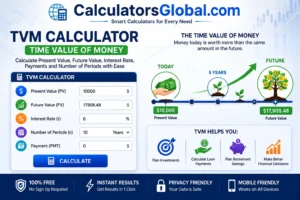
The TVM Calculator (Time Value of Money Calculator) helps you understand how money changes in value over time. It can be used to calculate the present value (PV), future value (FV), interest rate, number of periods, and periodic payment of an investment or cash flow. Check More Calculators like Percentage Calculator Compound Interest Calculator Currency Converter Investment Calculator EMI Calculator Mortgage Calculator
Financial Calculator
The basic idea behind the time value of money is simple: money available today is generally worth more than the same amount received in the future, because money available today can potentially earn interest or investment returns.
For example, if you have $10,000 today and can earn 5% annually, that money can grow over time. Therefore, $10,000 today and $10,000 received five years from now do not have the same economic value.
Our TVM Calculator makes these calculations easier by allowing you to enter the relevant financial variables and estimate how money grows, declines, or changes in value over time.
Quick Answer: The Time Value of Money (TVM) is the concept that money available today can be worth more than the same amount in the future because it can earn interest or investment returns. A TVM Calculator uses variables such as present value, future value, interest rate, number of periods, and payment to calculate the value of money over time.
What Is a TVM Calculator?
A TVM Calculator is a financial calculator designed to solve Time Value of Money problems.
TVM calculations are commonly used in:
- Personal finance
- Investment planning
- Retirement planning
- Loan analysis
- Mortgage calculations
- Business finance
- Capital budgeting
- Savings planning
- Annuity calculations
- Financial education
A typical TVM calculation involves five major variables:
- PV = Present Value
- FV = Future Value
- PMT = Periodic Payment
- r = Interest Rate per Period
- n = Number of Periods
Depending on what information you already know, a TVM calculator can solve for the missing variable.
For example, you may know that you have $5,000 today and want to know how much it will be worth after 10 years at a 6% annual interest rate.
Or you may know that you need $100,000 in 15 years and want to determine how much you need to invest today.
These are classic time value of money calculations.
What Is the Time Value of Money?
The Time Value of Money (TVM) is a fundamental financial concept stating that a sum of money available today can be worth more than the same amount in the future.
The reason is the opportunity to earn a return on money that is available now.
Suppose you receive $10,000 today.
If you invest that money and earn a return, it could become more than $10,000 in the future.
For example, at a 5% annual rate:
$10,000 today → $10,500 after one year
The future amount depends on the interest rate, compounding frequency, and length of time.
This is why financial professionals consider both the amount of money and when that money is received or paid.
Simple Explanation of TVM
Imagine someone offers you two choices:
Option A: Receive $10,000 today.
Option B: Receive $10,000 five years from now.
If you can invest money and earn a positive return, Option A may be financially more valuable because you can invest the money immediately.
That difference in value is the basic idea behind the time value of money.
Why Does Money Have a Time Value?
Several factors contribute to the time value of money.
1. Earning Potential
Money available today can potentially be invested to generate returns.
2. Inflation
Prices can rise over time, reducing the purchasing power of money.
For example, $10,000 may purchase fewer goods in the future if prices increase.
3. Risk
Future payments may carry uncertainty.
A promised payment in the future is not always equivalent to money already received.
4. Opportunity Cost
If you choose to receive money later, you may miss opportunities to invest or use the money today.
5. Interest
Interest allows money to grow over time.
These factors make the timing of cash flows important in financial decisions.
How Does a TVM Calculator Work?
A Time Value of Money Calculator uses a mathematical relationship between present value, future value, interest rate, payment, and time.
A typical TVM equation is:
[
FV = PV(1+r)^n
]
Where:
- FV = Future Value
- PV = Present Value
- r = Interest rate per period
- n = Number of periods
When regular payments are involved, the calculation becomes an annuity calculation.
A TVM calculator can use these relationships to solve for different financial variables.
For example, if PV, r, and n are known, the calculator can determine FV.
If FV, r, and n are known, it can determine PV.
This makes a TVM calculator useful for both investment and borrowing decisions.
TVM Calculator Variables
Understanding the main variables makes it much easier to use a TVM financial calculator.
| Variable | Meaning | Example |
|---|---|---|
| PV | Present Value | $10,000 |
| FV | Future Value | $15,000 |
| PMT | Periodic Payment | $500 |
| r | Interest Rate per Period | 6% |
| n | Number of Periods | 10 |
| I/Y | Interest Rate | 6% |
| N | Number of Periods | 10 |
The exact labels may vary between financial calculators.
Present Value (PV)
Present Value represents the value of future money in today’s terms.
For example, if you expect to receive $20,000 in five years, its present value may be less than $20,000 when discounted at a positive interest rate.
Future Value (FV)
Future Value represents what money today may grow to in the future.
For example, $10,000 invested at a positive return can become more than $10,000 over time.
Periodic Payment (PMT)
PMT represents a regular payment or contribution.
Examples include:
- Monthly investment
- Monthly loan payment
- Annual pension payment
- Regular savings contribution
Interest Rate (r)
The interest rate determines how quickly money grows or how heavily future money is discounted.
Number of Periods (n)
This represents the number of compounding or payment periods.
If interest compounds monthly for five years:
n = 5 × 12 = 60 periods
Time Value of Money Formula
The basic time value of money formula for a single future amount is:
[
FV = PV(1+r)^n
]
To calculate present value:
[
PV = \frac{FV}{(1+r)^n}
]
These formulas assume that the interest rate and compounding periods are correctly matched.
For example, if interest is compounded monthly, the rate should generally be expressed as a monthly rate and the number of periods should be expressed in months.
Present Value Formula
The present value formula determines what a future amount is worth today.
[
PV = \frac{FV}{(1+r)^n}
]
Example
Suppose you will receive:
FV = $10,000
in:
n = 5 years
and the discount rate is:
r = 6%
Then:
[
PV = \frac{10,000}{(1.06)^5}
]
The present value is approximately:
$7,473.96
This means that, at a 6% discount rate, approximately $7,474 today has the same financial value as $10,000 received five years from now.
Future Value Formula
The future value formula calculates how much a current amount may become after earning a specified rate for a certain period.
[
FV = PV(1+r)^n
]
Example
Suppose:
- PV = $10,000
- r = 5%
- n = 5 years
Then:
[
FV = 10,000(1.05)^5
]
The future value is approximately:
$12,762.82
So $10,000 invested at 5% annually for five years would grow to approximately $12,763, assuming annual compounding and no additional deposits.
Interest Rate Formula
If the present value, future value, and number of periods are known, the interest rate can be calculated using:
[
r = \left(\frac{FV}{PV}\right)^{1/n}-1
]
Example
Suppose:
- PV = $10,000
- FV = $15,000
- n = 5 years
Then:
[
r = \left(\frac{15,000}{10,000}\right)^{1/5}-1
]
The implied annual growth rate is approximately:
8.45%
This type of calculation is useful when you know the starting amount and ending amount and want to estimate the required annual growth rate.
Number of Periods Formula
If you know the present value, future value, and interest rate, you can solve for the number of periods.
Starting with:
[
FV = PV(1+r)^n
]
The number of periods can be rearranged as:
[
n = \frac{\ln(FV/PV)}{\ln(1+r)}
]
This formula can help determine how long it may take for an investment to grow from one amount to another at a specified rate.
Payment Formula
When regular payments are involved, the TVM calculation becomes more useful for real-world financial planning.
For an ordinary annuity, the future value of regular payments can be expressed as:
[
FV = PMT \times \frac{(1+r)^n-1}{r}
]
Where:
- FV = Future value
- PMT = Regular payment
- r = Rate per period
- n = Number of periods
For example, if you invest the same amount every month, a TVM calculator can estimate how much those contributions may grow to over time.
TVM Calculator Examples
Let’s look at several practical examples.
Example 1: One-Time Investment
You invest:
$10,000
at:
6% annual interest
for:
10 years
Using:
[
FV = PV(1+r)^n
]
we get:
[
FV = 10,000(1.06)^{10}
]
The future value is approximately:
$17,908.48
Therefore, assuming annual compounding and no additional deposits, the investment would grow to about $17,908.
Future Value Example
Suppose you currently have $5,000.
You expect to earn 7% annually for 8 years.
Inputs:
| Variable | Value |
|---|---|
| Present Value | $5,000 |
| Interest Rate | 7% |
| Period | 8 years |
| Additional Payments | $0 |
Formula:
[
FV = 5,000(1.07)^8
]
Future Value:
Approximately $8,590.73
The calculation demonstrates the effect of compound growth over time.
Present Value Example
Suppose you want to receive $25,000 in 10 years.
The discount rate is 6%.
You can calculate the present value:
[
PV = \frac{25,000}{(1.06)^{10}}
]
The result is approximately:
$13,969.60
This means $13,970 today would be financially equivalent to $25,000 received in ten years when using a 6% discount rate.
Monthly Investment Example
Suppose you invest:
$300 per month
for:
20 years
at an annual return of:
6%
Assuming monthly compounding:
- Monthly rate = 6% ÷ 12
- Number of periods = 20 × 12
- Monthly payment = $300
The TVM calculation can estimate the future value of the recurring contributions.
This example demonstrates why regular contributions can become significant over long periods.
The longer the investment period, the more opportunity there is for compound growth.
Loan Payment Example
TVM principles are also important when calculating loan payments.
Suppose you borrow:
$20,000
at:
7% annual interest
for:
5 years
with monthly payments.
The TVM calculation can be used to determine the required monthly payment.
For monthly payments:
Monthly interest rate = 7% ÷ 12
Number of payments = 5 × 12 = 60
A financial calculator can then determine the periodic payment.
This is one reason TVM concepts are closely related to loan calculators, mortgage calculators, and payment calculators.
TVM Calculator for Investments
Investors can use a TVM calculator for investments to estimate how money may change in value over time.
Common questions include:
- How much will my investment be worth in 10 years?
- How much should I invest today?
- How much do I need to save each month?
- What annual return is required to reach my target?
- How long will it take to reach my financial goal?
For example, someone saving for a long-term goal may compare different investment periods.
| Investment Period | Effect |
|---|---|
| 5 years | Shorter growth period |
| 10 years | More time for compounding |
| 20 years | Significant compounding potential |
| 30 years | Long-term growth opportunity |
The calculator does not guarantee investment returns. It simply performs the mathematical calculation based on the assumptions entered.
TVM Calculator for Loans
A TVM calculator for loans can help explain how borrowing costs work.
For a loan, the important variables may include:
- Loan amount
- Interest rate
- Loan term
- Payment frequency
- Number of payments
- Periodic payment
For example, increasing the interest rate while keeping the loan amount and term constant generally increases the required payment.
Likewise, extending the loan term can reduce the periodic payment but may increase the total interest paid.
A TVM calculator helps illustrate these relationships.
TVM Calculator for Retirement Planning
The time value of money is especially important in retirement planning.
Suppose you want to accumulate $500,000 over 25 years.
You may want to know:
- How much should I invest today?
- How much should I contribute each month?
- What return would be required?
- How does the target change if the investment period changes?
A TVM calculator can help model different scenarios.
For example:
Scenario A: $500 monthly contribution
Scenario B: $750 monthly contribution
Scenario C: $1,000 monthly contribution
Comparing these scenarios can demonstrate how contribution size and time affect future value.
Actual investment results can differ substantially from assumed returns.
TVM Calculator vs Compound Interest Calculator
A TVM Calculator and a Compound Interest Calculator overlap, but they are not exactly the same.
| Feature | TVM Calculator | Compound Interest Calculator |
|---|---|---|
| Present Value | Yes | Usually |
| Future Value | Yes | Yes |
| Interest Rate | Yes | Yes |
| Number of Periods | Yes | Yes |
| Periodic Payment | Often | Sometimes |
| Loan Applications | Yes | Usually limited |
| Annuity Calculations | Yes | Sometimes |
| Financial Modeling | Broad | More focused |
A compound interest calculator is usually focused on how money grows through compounding.
A TVM calculator is broader and can work with present value, future value, payments, interest rates, and periods.
TVM Calculator vs NPV Calculator
The TVM Calculator and NPV Calculator are also related.
TVM Calculator
Focuses on the value of individual cash flows or payment streams over time.
NPV Calculator
Net Present Value (NPV) evaluates a series of future cash flows by discounting them to their present value and comparing them with an initial investment.
NPV is particularly useful in business and investment analysis.
| Feature | TVM Calculator | NPV Calculator |
|---|---|---|
| Future Value | Yes | Not the primary purpose |
| Present Value | Yes | Yes |
| Regular Payments | Yes | Cash-flow series |
| Multiple Cash Flows | Limited/depends on calculator | Yes |
| Investment Project Analysis | Useful | Excellent |
| Discount Rate | Yes | Yes |
Simple Interest vs Time Value of Money
Simple interest and TVM are related but different concepts.
Simple Interest
Simple interest generally calculates interest only on the original principal.
The basic formula is:
[
I = PRT
]
Where:
- P = Principal
- R = Rate
- T = Time
Compound Growth
Compound growth calculates returns on both the original amount and previously accumulated returns.
[
FV = PV(1+r)^n
]
This difference becomes increasingly important over long periods.
Factors That Affect the Time Value of Money
Several variables can significantly change TVM calculations.
Interest Rate
A higher rate generally increases the future value of an investment.
Time
More time can provide more opportunity for compounding.
Payment Amount
Larger regular contributions generally lead to a larger future value, assuming other factors remain constant.
Payment Frequency
Monthly, quarterly, and annual payments can produce different results depending on the interest rate and compounding assumptions.
Compounding Frequency
Interest may compound:
- Annually
- Semi-annually
- Quarterly
- Monthly
- Daily
The compounding frequency can affect the final result.
Inflation
Nominal money values do not necessarily represent purchasing power.
A future amount may be larger in dollars but worth less in real purchasing-power terms if inflation is significant.
Advantages of Using a TVM Calculator
Saves Time
Manual financial calculations can involve logarithms, exponents, and multiple variables.
A calculator performs these calculations quickly.
Reduces Calculation Errors
Entering the correct values into a calculator can reduce arithmetic mistakes.
Useful for Financial Planning
TVM calculations can help compare savings and investment scenarios.
Easy Scenario Testing
You can change:
- Interest rate
- Time period
- Payment
- Starting amount
and compare the results.
Helps Explain Financial Concepts
Students and beginners can use TVM calculators to understand how money changes over time.
Common TVM Calculation Mistakes
Mistake 1: Mixing Annual and Monthly Rates
If payments are monthly, you generally need to use a monthly rate and the total number of monthly periods.
For example:
6% annual rate
with monthly compounding commonly becomes:
6% ÷ 12 = 0.5% per month
and five years becomes:
5 × 12 = 60 months
Mistake 2: Using the Wrong Number of Periods
Ten years of monthly payments is:
10 × 12 = 120 periods
not 10 periods.
Mistake 3: Ignoring Payment Timing
Annuity payments can occur at the beginning or end of a period.
These are known as:
- Ordinary annuity
- Annuity due
The difference can affect the result.
Mistake 4: Confusing Interest Rate With Return
A calculated rate is an assumption or mathematical result. Actual investment returns may vary.
Mistake 5: Ignoring Inflation
A future dollar amount is not necessarily equal to the same purchasing power today.
How to Use a TVM Calculator Correctly
Before entering numbers, identify what you already know.
Step 1: Identify the Known Variables
Determine whether you know:
- PV
- FV
- PMT
- Interest rate
- Number of periods
Step 2: Match the Rate to the Period
If the period is monthly, use the appropriate monthly rate.
Step 3: Enter the Number of Periods
For monthly calculations:
Years × 12 = Number of periods
Step 4: Enter Payments Correctly
Make sure payments are entered as positive or negative values according to the calculator’s convention.
Step 5: Calculate the Missing Value
The calculator can then solve for the unknown variable.
Step 6: Review the Result
Check whether the answer makes sense.
For example, if you enter a positive interest rate and expect an investment’s future value, the result should generally be higher than the starting amount when there are no withdrawals or negative cash flows.
Real-Life Applications of Time Value of Money
TVM is not just a classroom concept.
It appears in everyday financial decisions.
Savings Accounts
You can estimate how savings may grow over time.
Fixed Deposits
TVM principles can help calculate the future value of deposits.
Retirement Accounts
Regular contributions can be modeled using future-value calculations.
Home Loans
Mortgage payments involve present value and periodic payment calculations.
Car Loans
Auto financing is another practical TVM application.
Business Investments
Businesses can compare the value of current investments against expected future cash flows.
Bonds
Bond valuation relies heavily on discounting future cash flows.
Annuities
Pension and annuity payments can be evaluated using TVM concepts.
Education Planning
Families can estimate how much money may be required in the future for education expenses.
Why Time Matters in Financial Planning
One of the most important lessons from TVM is that time can significantly influence financial outcomes.
Consider two people who invest the same amount of money but start at different ages.
The person who starts earlier has more time for compounding.
This is why starting to save and invest early can be financially valuable.
The TVM concept does not guarantee a specific investment outcome. Instead, it provides a mathematical framework for understanding how rates, time, and cash flows interact.
TVM and Inflation
Inflation is an important consideration when thinking about the time value of money.
Suppose you have $10,000 today.
If prices rise over the next decade, the same $10,000 may not purchase the same quantity of goods and services.
Therefore, financial planning often considers both:
Nominal Value
and
Real Value
A TVM calculation may tell you that an investment grows from $10,000 to $18,000.
But that does not automatically mean your purchasing power increased by the same amount.
Inflation needs to be considered separately.
TVM and Compound Growth
Compounding is one of the most important ideas connected with TVM.
When returns are reinvested, future growth can occur on both:
- Original principal
- Previously earned returns
This creates a compounding effect.
For example, an investment that earns 5% does not necessarily grow by the same dollar amount every year because the base amount can change as returns accumulate.
Over long periods, this can produce a significant difference compared with simple interest.
Frequently Asked Questions
What does TVM stand for?
TVM stands for Time Value of Money.
It is the financial principle that money available today can have a different economic value from the same amount received in the future.
What is a TVM Calculator?
A TVM Calculator is a financial tool used to calculate variables such as present value, future value, payment, interest rate, and number of periods.
What is the basic TVM formula?
For a single future amount, a common TVM formula is:
[
FV = PV(1+r)^n
]
What is present value in TVM?
Present value is the current value of a future amount after accounting for a specified discount rate and time period.
What is future value in TVM?
Future value is the amount a current investment or series of payments may grow to after a specified period and rate.
What does PMT mean in a TVM calculator?
PMT generally represents the periodic payment or contribution.
What does PV mean?
PV means Present Value.
It represents the value of money at the current point in time.
What does FV mean?
FV means Future Value.
It represents the value of money at a specified future date.
Can a TVM calculator calculate loan payments?
Yes. TVM calculations can be used to determine periodic loan payments when the loan amount, interest rate, and term are known.
Can I use a TVM calculator for investments?
Yes. TVM calculators are useful for estimating investment growth, required contributions, present values, and future values.
Is TVM the same as compound interest?
No. Compound interest is one mechanism through which money can grow over time. TVM is a broader financial concept that considers the value and timing of cash flows.
Is a TVM Calculator accurate?
A TVM calculator can accurately perform the mathematical calculation based on the inputs provided. However, the result depends on the assumptions and inputs being correct.
Does TVM account for inflation?
A standard TVM calculation does not automatically account for inflation unless an inflation-adjusted rate or separate real-value analysis is used.
What happens when the interest rate increases?
For a positive investment balance, a higher rate generally increases future value and can reduce the present value of a fixed future amount when used as a discount rate.
Why is time important in TVM?
Time affects how long money can earn returns or how long future cash flows need to be discounted.
Can TVM be used for monthly payments?
Yes. TVM calculations can be performed using monthly payments, provided the interest rate and number of periods are matched correctly.
What is an annuity in TVM?
An annuity is a series of equal payments made at regular intervals. Examples include certain loan payments, savings contributions, and pension payments.
What is an ordinary annuity?
An ordinary annuity has payments made at the end of each period.
What is an annuity due?
An annuity due has payments made at the beginning of each period.
Can TVM predict investment returns?
No. A TVM calculator can calculate outcomes based on an assumed rate, but it cannot predict actual future investment performance.
Final Thoughts on the TVM Calculator
The TVM Calculator is a useful financial tool for understanding how the value of money changes over time.
The core concept is straightforward: a dollar available today can potentially earn a return, which means its value may differ from the same dollar received later.
By using variables such as present value, future value, payment, interest rate, and number of periods, you can analyze a wide range of financial situations.
TVM calculations can help with:
- Investment planning
- Retirement savings
- Loan payments
- Mortgage analysis
- Annuities
- Business investments
- Long-term savings
- Financial education
The most important thing is to use consistent assumptions. Match the interest rate to the payment period, use the correct number of periods, and understand whether payments occur at the beginning or end of each period.
Also remember that a mathematical TVM result is not a guarantee of future financial performance. Investment returns, inflation, taxes, fees, and other real-world factors can affect actual outcomes.
Use the CalculatorsGlobal.com TVM Calculator to quickly explore different scenarios and understand how today’s money can change in value over time.
Disclaimer
Disclaimer: The TVM Calculator is provided for educational and informational purposes. Calculations are based on the values and assumptions entered by the user and should not be considered financial, investment, tax, or legal advice.