A Bond Calculator is an online tool that helps you understand the value and potential return of a bond. Depending on the type of calculation, you can use it to estimate the bond price, coupon payment, current yield, yield to maturity (YTM), maturity value, total interest, and overall bond return.
Bond Calculator: Calculate Bond Price, Yield, Interest and Returns
Buying a bond can look simple at first. You invest money, receive interest, and get the principal back when the bond matures. But the real return from a bond depends on more than just the interest rate printed on the bond.
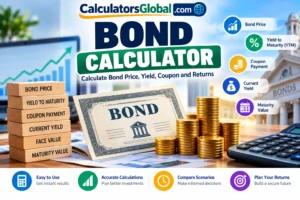
The price you pay, face value, coupon rate, market yield, time to maturity, and coupon payment frequency can all affect your actual return.
This is where a Bond Calculator can help.
If you are comparing government bonds, corporate bonds, Treasury securities, or other fixed-income investments, a bond calculator can make the numbers much easier to understand.
In this guide, we will explain what a bond calculator is, how bond calculations work, how to calculate bond price and yield, what YTM means, how coupon payments work, and how bond prices change when interest rates move.
What Is a Bond Calculator?
A Bond Calculator is a financial calculator used to estimate different values related to a bond investment.
A bond calculator can help answer questions such as:
- How much is a bond worth today?
- How much interest will the bond pay?
- What is the annual coupon income?
- What is the current yield?
- What is the yield to maturity?
- Will the bond trade at a premium or discount?
- How much will I receive at maturity?
- How much total return could I earn?
- What happens if the bond price changes?
- How does the market interest rate affect the bond price?
Instead of calculating these values manually, you can enter the required bond information into an online bond calculator and get an estimate quickly.
What Does a Bond Calculator Calculate?
The exact features depend on the calculator, but a comprehensive bond calculator can be used for several common calculations.
Bond Price
The bond price is the amount an investor pays to buy the bond in the market.
A bond can trade:
- Above its face value
- Below its face value
- At its face value
For example, if a bond has a face value of $1,000 but its market price is $950, you are buying it at a discount.
Face Value
Face value, also called par value, is the amount the bond issuer generally promises to repay at maturity, subject to the issuer meeting its obligations.
For example:
Face Value = $1,000
At maturity, the bond may return $1,000 to the investor.
Coupon Rate
The coupon rate is the annual interest rate stated on the bond, usually based on its face value.
For example, a $1,000 bond with a 5% annual coupon has:
Annual Coupon = $1,000 × 5%
Annual Coupon = $50
The coupon rate itself usually does not change for a fixed-rate bond, although the investor’s actual yield can change when the market price changes.
Current Yield
Current yield compares the bond’s annual coupon income with the price you pay for the bond.
The basic formula is:
Current Yield = Annual Coupon ÷ Current Bond Price × 100
For example, suppose:
- Face value = $1,000
- Coupon rate = 5%
- Annual coupon = $50
- Market price = $900
Then:
Current Yield = $50 ÷ $900 × 100
Current Yield ≈ 5.56%
This is higher than the 5% coupon rate because the bond is being purchased below face value.
Yield to Maturity (YTM)
Yield to Maturity, commonly called YTM, is one of the most important bond investment measures.
YTM estimates the annualized return an investor would receive if the bond is held until maturity, assuming the required conditions and cash flows occur as expected.
YTM considers:
- Purchase price
- Face value
- Coupon payments
- Time remaining to maturity
- Coupon frequency
This makes YTM more useful than looking at the coupon rate alone when comparing bonds bought at different prices.
How Does a Bond Calculator Work?
A bond calculator uses the bond’s cash flows and time value of money to estimate its value or return.
For a basic fixed-rate bond, future cash flows usually include:
- Regular coupon payments
- Repayment of face value at maturity
The bond price represents the present value of these future cash flows when discounted at the market yield.
In simple terms:
Bond Price = Present Value of Coupon Payments + Present Value of Face Value
The calculation can become complicated when coupons are paid multiple times per year, which is why using an online bond calculator is easier than doing the calculation manually.
How to Use a Bond Calculator
Using a bond calculator is usually straightforward.
The exact fields may vary depending on the calculator, but you will normally need some combination of the following information.
Step 1: Enter the Face Value
Enter the bond’s face value or par value.
For example:
$1,000
This is the amount generally returned at maturity if the bond is held until maturity and the issuer fulfills its obligation.
Step 2: Enter the Coupon Rate
Enter the annual coupon rate.
For example:
5%
This tells the calculator how much annual coupon interest the bond generates based on its face value.
Step 3: Enter the Bond Price
If you are calculating yield, enter the price you currently pay for the bond.
For example:
$950
The difference between the purchase price and face value can affect the yield you receive if the bond is held until maturity.
Step 4: Enter Years to Maturity
Enter the remaining time before the bond matures.
For example:
10 years
A bond with 10 years remaining has more future coupon payments than a bond with only one year remaining, assuming the same payment frequency.
Step 5: Select Coupon Frequency
Some bonds pay interest:
- Annually
- Semi-annually
- Quarterly
- Monthly
For example, if a $1,000 bond has a 5% annual coupon and pays twice a year:
Annual coupon = $50
Each payment = $50 ÷ 2
Each coupon payment = $25
Step 6: Calculate
Enter the information and click the calculator’s Calculate button.
The result can help you understand the bond’s price, yield, coupon income, maturity value, or other relevant figures.
Bond Calculator Example
Let’s use a simple example.
Suppose you are considering a bond with:
| Bond Detail | Example |
|---|---|
| Face Value | $1,000 |
| Market Price | $950 |
| Coupon Rate | 5% |
| Years to Maturity | 10 years |
| Coupon Frequency | Semi-annual |
The annual coupon income is:
$1,000 × 5% = $50
Because the bond pays twice per year:
$50 ÷ 2 = $25 per payment
You pay $950 today but may receive $1,000 at maturity if the issuer pays the stated face value.
That $50 difference, together with the coupon payments, affects your overall return.
This is why looking only at the coupon rate does not always tell you the complete investment picture.
What Is a Coupon Payment?
A coupon payment is the interest payment made by a bond issuer to the bondholder.
For example, assume:
- Face value = $1,000
- Coupon rate = 6%
Annual coupon income:
$1,000 × 6% = $60
If interest is paid twice a year:
$60 ÷ 2 = $30
You would receive approximately $30 per coupon payment, assuming the bond terms specify semi-annual payments.
What Is the Difference Between Coupon Rate and Yield?
This is one of the most common questions about bonds.
The coupon rate is the interest rate stated on the bond.
The yield depends on the price you pay and the cash flows you receive.
For example, imagine a bond with:
Face Value = $1,000
Coupon Rate = 5%
Annual coupon:
$50
If you buy the bond for $1,000, the annual coupon is 5% of your purchase price.
But if you buy the same bond for $900:
$50 ÷ $900 × 100 = 5.56%
Your current yield is now approximately 5.56%.
The coupon rate has not changed. The price changed.
What Is Yield to Maturity?
Yield to Maturity (YTM) estimates the annualized return from a bond if it is held until maturity, based on its purchase price, coupon payments, face value, and remaining term.
YTM is useful because it considers more than the coupon payment.
For example, two bonds may both have a 5% coupon rate, but one could cost $950 while another costs $1,050.
The investor buying the $950 bond may have a different overall return because the purchase price is below face value.
Similarly, a bond purchased above face value can have a lower YTM than its coupon rate.
Bond Premium and Bond Discount
A bond can trade at a premium or discount to its face value.
Bond Trading at a Premium
A bond trades at a premium when its market price is higher than its face value.
Example:
Face Value = $1,000
Market Price = $1,050
The bond is trading at a $50 premium.
Bond Trading at a Discount
A bond trades at a discount when its market price is below its face value.
Example:
Face Value = $1,000
Market Price = $950
The bond is trading at a $50 discount.
Bond Trading at Par
A bond trades at par when its market price equals its face value.
Example:
Face Value = $1,000
Market Price = $1,000
Understanding premium and discount is important when comparing bonds.
Why Do Bond Prices Change?
Bond prices can change because market interest rates change.
There is generally an inverse relationship between bond prices and market yields.
When market interest rates rise, existing fixed-rate bonds can become less attractive because newly issued bonds may offer higher yields. As a result, the price of existing bonds can fall.
When market interest rates fall, existing bonds with higher coupon rates can become more attractive, which can push their market prices higher.
This is an important reason why bond investors should understand both bond price and bond yield.
Bond Price Formula
A simplified bond pricing formula can be written as:
Bond Price = Present Value of Coupon Payments + Present Value of Face Value
For a bond with regular coupon payments, the mathematical formula is:
P = C × [1 − (1 + r)^−n] ÷ r + F ÷ (1 + r)^n
Where:
- P = Bond price
- C = Coupon payment per period
- r = Required yield per period
- n = Number of remaining periods
- F = Face value
If coupons are paid twice a year, the annual coupon rate and annual yield are generally adjusted to a per-period basis, and the number of periods is doubled.
Because these calculations can become difficult, a bond price calculator is useful for quick estimates.
Bond Yield Formula
Some bond yields can be estimated using simple formulas.
For example, current yield is:
Current Yield = Annual Coupon ÷ Market Price × 100
However, YTM is more complicated because it considers coupon payments, purchase price, face value, and time to maturity.
There is generally no simple one-line algebraic solution for YTM in the standard case, so financial calculators and spreadsheets typically solve for the yield numerically.
Bond Calculator for YTM
A Bond YTM Calculator can be useful when you know:
- Bond price
- Face value
- Coupon rate
- Years to maturity
- Coupon frequency
The calculator can estimate the yield to maturity from these values.
For investors comparing different bonds, YTM can provide a more complete way to compare potential returns than simply looking at coupon rates.
Bond Calculator for Current Yield
A current yield calculator is useful when you want to compare annual coupon income with the bond’s current market price.
For example:
Face value:
$1,000
Coupon rate:
4%
Annual coupon:
$40
Market price:
$800
Current yield:
$40 ÷ $800 × 100
Current Yield = 5%
Notice that the coupon rate is 4%, while the current yield is 5%.
The difference comes from the bond’s market price.
Bond Maturity Calculator
A bond maturity calculator can help you understand the value or cash flow you may receive when the bond reaches its maturity date.
For a standard bond held until maturity, the investor may receive:
- Final coupon payment
- Face value repayment
For example, a $1,000 bond may return $1,000 at maturity, subject to the issuer meeting its obligations.
If the bond was purchased for $950, the investor may also have a $50 difference between purchase price and face value.
If it was purchased for $1,050, the investor may face a $50 loss on the principal value at maturity, before considering coupon income.
Bond Return Calculator
A bond return calculator can help estimate the overall return from a bond investment.
Your overall bond return can be affected by:
- Purchase price
- Coupon income
- Face value
- Time to maturity
- Sale price
- Reinvestment of coupon payments
- Transaction costs
- Taxes
This is why a bond investment should not be judged only by its coupon rate.
Zero-Coupon Bond Calculator
A zero-coupon bond works differently from a traditional coupon-paying bond.
Instead of making regular coupon payments, a zero-coupon bond is generally issued or purchased at a discount and pays its face value at maturity.
For example:
Purchase Price = $700
Face Value = $1,000
At maturity, the investor receives the face value if the issuer meets its obligation.
The difference between the purchase price and maturity value contributes to the investor’s return.
A zero-coupon bond calculator can help estimate the price, return, or yield of this type of bond.
Bond Calculator for Government Bonds
A bond calculator can also be useful when evaluating government bonds.
Depending on the country, investors may have access to:
- Government securities
- Treasury bonds
- Treasury notes
- Treasury bills
- Sovereign bonds
- State or local government bonds
Government bonds can have different maturities, coupon structures, taxation rules, and market prices.
Always check the specific terms of the security you are considering.
Bond Calculator for Corporate Bonds
Companies can also issue bonds to raise money.
A corporate bond calculator can help investors compare corporate bonds based on:
- Price
- Coupon rate
- Yield
- Maturity
- Credit risk
- Expected cash flow
A higher yield does not automatically mean a better investment. Higher yields can sometimes reflect greater credit or market risk.
How to Compare Two Bonds
A bond calculator becomes especially useful when comparing two or more bonds.
Suppose you have:
| Feature | Bond A | Bond B |
|---|---|---|
| Face Value | $1,000 | $1,000 |
| Coupon Rate | 4% | 5% |
| Market Price | $950 | $1,050 |
| Maturity | 5 years | 5 years |
At first glance, Bond B appears better because it has a higher coupon.
But Bond B costs more than its face value.
Bond A costs less than face value.
The actual return depends on all of these factors, not just the coupon rate.
This is where comparing YTM, current yield, coupon income, and purchase price becomes useful.
What Factors Affect Bond Returns?
Several factors can influence your actual bond return.
Interest Rates
Changes in market interest rates can affect bond prices.
Coupon Rate
A higher coupon can provide more regular income, assuming all other terms are equal.
Purchase Price
Buying below or above face value affects your potential return.
Time to Maturity
A longer maturity means more time for coupon payments and more exposure to changes in market conditions.
Credit Risk
The issuer’s ability to make payments is an important consideration.
Taxes
Tax treatment can vary depending on the bond and the investor’s location.
Inflation
Inflation can reduce the purchasing power of future fixed payments.
Why Use a Bond Calculator?
A bond calculator can make fixed-income calculations much easier.
Easy Bond Calculations
You do not need to manually calculate every future cash flow.
Understand Your Potential Return
You can look beyond the coupon rate and examine yield and other measures.
Compare Different Bonds
Change the bond price, coupon rate, or maturity to compare different scenarios.
Understand Premium and Discount
See how buying above or below face value can affect your yield.
Plan Your Investment
A calculator can help you understand the numbers before making an investment decision.
Common Bond Calculator Mistakes
Looking Only at the Coupon Rate
A 6% coupon does not automatically mean you will earn a 6% return on the money you invest.
Your purchase price matters.
Ignoring the Market Price
The same bond can offer different yields at different market prices.
Confusing Coupon Rate With YTM
Coupon rate is stated on the bond. YTM considers the purchase price and other cash flows.
Ignoring Maturity
A bond with a short remaining maturity can behave differently from a long-term bond.
Forgetting Taxes and Fees
Calculator results may not include every tax, brokerage charge, transaction cost, or other expense.
Frequently Asked Questions About Bond Calculators
What is a Bond Calculator?
A Bond Calculator is an online financial tool used to estimate bond price, coupon income, yield, maturity value, current yield, yield to maturity, and other bond-related calculations.
What is a Bond Price Calculator?
A Bond Price Calculator estimates the fair or theoretical value of a bond based on its future coupon payments, face value, remaining maturity, and required yield.
What is a Bond Yield Calculator?
A Bond Yield Calculator helps estimate the return or yield associated with a bond based on its price, coupon, face value, and maturity.
What is a YTM Calculator?
A YTM Calculator estimates the Yield to Maturity, which is the annualized return implied by a bond’s price and future cash flows if held until maturity, subject to the assumptions of the calculation.
How is bond price calculated?
Bond price is generally calculated as the present value of the bond’s future coupon payments plus the present value of its face value at maturity.
What is the difference between face value and market price?
Face value is the amount generally paid at maturity. Market price is the price investors currently pay to buy the bond.
What is a coupon rate?
The coupon rate is the annual interest rate stated on a bond, usually calculated as a percentage of its face value.
How do I calculate a coupon payment?
A simple annual coupon payment can be calculated as:
Coupon Payment = Face Value × Coupon Rate
If the bond pays twice per year, divide the annual coupon by two.
What is current yield?
Current yield is the annual coupon income divided by the current market price of the bond.
Current Yield = Annual Coupon ÷ Market Price × 100
Why does bond price fall when interest rates rise?
When new bonds offer higher yields, existing bonds with lower coupons can become less attractive. Their market prices may therefore fall so that their yields become more competitive.
Is YTM better than coupon rate?
YTM can provide more information because it considers the bond’s purchase price, coupon payments, maturity, and face value. However, investors should also consider credit risk, taxes, liquidity, and other factors.
What does a bond trading at a discount mean?
A bond is trading at a discount when its market price is below its face value.
For example:
Face Value = $1,000
Market Price = $900
The bond is trading at a $100 discount.
What does a bond trading at a premium mean?
A bond is trading at a premium when its market price is above its face value.
For example:
Face Value = $1,000
Market Price = $1,050
The bond is trading at a $50 premium.
Can I use a Bond Calculator for government bonds?
Yes, a bond calculator can be used to analyze many government bonds, provided you enter the correct bond terms and assumptions.
Can I use a Bond Calculator for corporate bonds?
Yes. A bond calculator can help estimate the price, coupon income, and yield of many corporate bonds. However, credit risk should also be considered.
What is a zero-coupon bond?
A zero-coupon bond generally does not make regular coupon payments. Instead, it is typically bought below face value and pays the face value at maturity if the issuer meets its obligation.
Are bond calculator results exact?
Calculator results are estimates based on the information entered and the assumptions used. Actual investment returns can differ because of market price changes, taxes, fees, credit events, reinvestment rates, and other factors.
Final Thoughts
A Bond Calculator is a simple way to understand the numbers behind a bond investment.
Instead of looking only at the coupon rate, you can compare the bond price, face value, coupon payment, current yield, yield to maturity, maturity value, and total return.
This can make it easier to compare different bonds and understand what you may actually earn from an investment.
Whether you are researching a government bond, corporate bond, Treasury security, zero-coupon bond, or another fixed-income investment, using a bond calculator can help you make sense of the numbers before making a decision.
The most important thing is to look at the complete picture. A higher coupon does not always mean a higher return, and a higher yield does not always mean a better investment.
Use the calculator to compare different scenarios, understand how bond prices and yields work, and then review the actual terms, risks, taxes, fees, and market conditions before investing.