
House Affordability Calculator to estimate how much house you can afford based on income, down payment, interest rate, debts and monthly budget. Home Loan Calculator — EMI Calculator — Mortgage Calculator — Salary Calculator — Interest Rate Calculator — Compound Interest Calculator — Percentage Calculator — Investment Calculator — Inflation Calculator.
House Affordability Calculator: Calculate How Much House You Can Afford
Buying a home is one of the biggest financial decisions most people make. Before searching for a property, it is important to understand how much house you can realistically afford without putting too much pressure on your monthly budget.
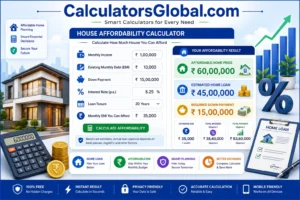
A House Affordability Calculator helps estimate the maximum home price you may be able to afford based on factors such as income, existing debts, down payment, mortgage or home-loan interest rate, loan tenure and monthly housing budget.
A bank may approve a certain loan amount, but that does not necessarily mean you should spend the maximum amount available. Your comfortable home budget should also consider everyday expenses, emergency savings, insurance, investments, education costs and unexpected expenses.
For example, a person earning ₹1,00,000 per month may technically qualify for a substantial home loan. However, if that person already has car-loan and personal-loan EMIs, the affordable house price could be considerably lower.
This is why home affordability is different from simply asking, “How much home loan can I get?”
A good house affordability calculation considers both your borrowing capacity and your personal budget. A House Affordability Calculator estimates the home price you can potentially afford based on income, existing debts, down payment, interest rate, loan tenure and a comfortable monthly housing payment. A common starting point is to keep total housing costs within a manageable portion of your monthly income, while also considering other financial commitments.
What Is a House Affordability Calculator?
A House Affordability Calculator is an online financial tool that estimates the price of a home you may reasonably be able to afford.
It typically considers:
- Monthly income
- Annual income
- Existing monthly debt payments
- Down payment
- Interest rate
- Loan tenure
- Desired monthly EMI
- Other housing expenses
The calculator can then estimate:
- Affordable home price
- Possible home-loan amount
- Estimated monthly EMI
- Required down payment
- Total borrowing cost
- Approximate affordability range
The exact calculation depends on the calculator’s methodology.
Why Is It Different From a Home Loan Calculator?
A Home Loan Calculator generally focuses on the loan itself.
For example, you might enter:
- Loan amount
- Interest rate
- Tenure
and calculate the EMI.
A House Affordability Calculator, on the other hand, starts from your financial situation and works toward an estimated home price.
In simple terms:
Home Loan Calculator: “What will my EMI be?”
House Affordability Calculator: “What home price can fit my budget?”
Both calculators are useful, but they answer different questions.
How Does a House Affordability Calculator Work?
A house affordability calculator generally follows several steps.
Step 1: Enter Your Income
Enter your monthly or annual income.
For example:
Monthly Income = ₹1,00,000
If calculating affordability for a household, you may also include eligible income from another borrower.
Step 2: Enter Existing Debt
Include existing monthly obligations such as:
- Personal loan EMI
- Car loan EMI
- Education loan EMI
- Credit-card payments
- Other recurring debt payments
For example:
Existing EMI = ₹15,000 per month
Step 3: Enter Down Payment
The down payment is the amount you plan to contribute toward the property purchase.
For example:
Down Payment = ₹10,00,000
Step 4: Enter Interest Rate
Enter the expected home-loan interest rate.
For example:
Interest Rate = 8% per year
The actual rate offered by a lender depends on several factors.
Step 5: Enter Loan Tenure
Loan tenure is the length of time over which you plan to repay the loan.
For example:
20 years
Step 6: Calculate
The calculator estimates your affordable loan and home price based on the information provided.
Why Should You Calculate Home Affordability?
Before making a large financial commitment, it is useful to know your realistic budget.
Prevents Over-Borrowing
A larger loan may allow you to buy a more expensive home, but it also creates a larger monthly obligation.
Helps With Property Searching
Knowing your price range allows you to focus on suitable properties instead of wasting time looking at homes outside your budget.
Helps Plan Your Down Payment
You can estimate how much cash you need before purchasing.
Helps Compare Loan Options
You can test different interest rates and tenures.
Protects Your Monthly Budget
A home should not consume so much of your income that you cannot comfortably manage everyday expenses and savings.
Helps With Long-Term Planning
A home loan can last for many years. Understanding affordability before purchasing can reduce financial stress later.
How Much House Can I Afford?
There is no single home price that is affordable for everyone with the same income.
Two people earning the same salary can have very different affordable budgets.
Consider two buyers:
Buyer A
- Income: ₹1,00,000/month
- Existing EMI: ₹5,000
- Savings: ₹20 lakh
Buyer B
- Income: ₹1,00,000/month
- Existing EMI: ₹30,000
- Savings: ₹5 lakh
Although their income is identical, Buyer A may have significantly greater purchasing flexibility.
This demonstrates why a house affordability calculation should consider more than salary.
House Affordability Formula
There is no single universal formula for determining house affordability.
A simplified approach starts by estimating the maximum comfortable housing payment.
For example:
Affordable Housing Payment = Monthly Income × Housing Budget Percentage
Then:
Available Home Loan = Loan Amount Supported by Affordable EMI
And:
Affordable Home Price = Home Loan + Down Payment
This is a simplified framework.
Actual affordability depends on lender criteria, interest rates, loan terms, taxes, insurance, maintenance and personal financial circumstances.
Income and Home Affordability
Income is one of the most important factors affecting home affordability.
Higher income generally provides more capacity for monthly housing payments, but income should not be considered alone.
You should also consider:
- Existing debts
- Household expenses
- Number of dependents
- Savings
- Emergency fund
- Retirement contributions
- Insurance
- Future financial goals
Gross Income vs Take-Home Income
A lender may evaluate income using specific eligibility rules.
For personal budgeting, however, take-home income is often more useful because it represents the money actually available after payroll deductions.
For example:
Gross Monthly Salary = ₹1,20,000
Take-Home Salary = ₹1,00,000
A personal budget should generally be built around the amount you actually receive rather than assuming the entire gross salary is available for spending.
Monthly Housing Budget
Your monthly housing budget can include more than the home-loan EMI.
Potential housing costs include:
- Home-loan EMI
- Property tax
- Home insurance
- Maintenance
- Society or association fees
- Repairs
- Utilities
- Parking charges
- Other property-related expenses
For example:
| Housing Cost | Monthly Amount |
|---|---|
| Home Loan EMI | ₹35,000 |
| Maintenance | ₹3,000 |
| Insurance/Other | ₹1,000 |
| Estimated Housing Cost | ₹39,000 |
This is why affordability should not be based exclusively on EMI.
Debt-to-Income Ratio
Debt-to-Income Ratio (DTI) compares your monthly debt obligations with your monthly income.
A simplified formula is:
DTI = Total Monthly Debt Payments ÷ Gross Monthly Income × 100
Suppose:
Monthly debt payments = ₹25,000
Gross monthly income = ₹1,00,000
Then:
DTI = ₹25,000 ÷ ₹1,00,000 × 100
DTI = 25%
Lenders may use their own eligibility criteria and may calculate debt obligations differently.
A lower debt burden generally leaves more room in the monthly budget for a home loan.
Home Loan Affordability
Home loan affordability depends on several variables.
The most important include:
- Income
- Existing EMIs
- Interest rate
- Loan tenure
- Down payment
- Credit profile
- Lender’s eligibility criteria
A higher income can increase potential borrowing capacity, while higher existing debt can reduce it.
Why EMI Matters
The EMI is one of the most important numbers when evaluating a home.
Suppose your estimated affordable EMI is:
₹40,000 per month
A loan that requires ₹55,000 per month may place unnecessary pressure on your finances, even if a lender approves it.
This is why you should distinguish:
Maximum eligible EMI
from
Comfortable EMI
The second is often more important for personal financial planning.
Down Payment and House Affordability
A larger down payment can reduce the amount you need to borrow.
For example:
Home Price = ₹60 lakh
If you contribute:
₹15 lakh down payment
then the remaining loan requirement is:
₹45 lakh
A larger down payment can potentially:
- Reduce loan amount
- Reduce EMI
- Reduce total interest
- Improve affordability
However, using all your savings for a down payment may leave insufficient money for emergencies and other costs.
Don’t Forget Buying Costs
When planning your down payment, consider additional expenses such as:
- Registration
- Stamp duty where applicable
- Legal fees
- Brokerage
- Processing fees
- Moving expenses
- Repairs
- Furnishing
These costs can significantly affect the cash required to purchase a property.
Interest Rate and Home Affordability
Interest rate has a major effect on the cost of borrowing.
Consider a hypothetical loan of ₹40 lakh.
A lower interest rate generally results in a lower EMI and lower total interest, assuming the loan amount and tenure remain unchanged.
A higher rate can increase both monthly payment and total borrowing cost.
Example
Suppose the loan amount is:
₹40,00,000
and the tenure is:
20 years
If the interest rate increases, the EMI generally increases.
This is why it is useful to test multiple interest-rate scenarios before purchasing.
Loan Tenure and Home Affordability
Loan tenure is another major factor.
A longer tenure can reduce the monthly EMI, but you may pay more total interest over the life of the loan.
A shorter tenure can increase the monthly EMI but may reduce total interest.
Simple Comparison
| Tenure | Monthly EMI | Total Interest |
|---|---|---|
| 10 years | Higher | Lower |
| 15 years | Moderate | Moderate |
| 20 years | Lower | Higher |
| 25 years | Lower | Higher |
| 30 years | Lowest | Usually highest |
Exact amounts depend on loan size and interest rate.
Property Taxes and Homeownership Costs
Buying a home involves more than the loan payment.
Depending on the property and location, you may have:
- Property tax
- Maintenance
- Home insurance
- Repairs
- Society charges
- Utilities
- Parking expenses
A house that appears affordable based solely on EMI may become less comfortable once all ownership costs are included.
House Affordability Calculator in India
A House Affordability Calculator India can help Indian home buyers estimate their potential home-buying budget using income, down payment, existing EMIs, interest rate and loan tenure.
For Indian buyers, additional purchase expenses may include:
- Stamp duty
- Registration charges
- Brokerage
- Legal expenses
- Home-loan processing charges
- Interior expenses
- Moving costs
- Maintenance
These costs vary by property, location and applicable rules.
Therefore, your total home-buying budget should include both the property price and related expenses.
House Affordability Calculator Based on Salary
Salary is a useful starting point for estimating affordability.
Consider:
Monthly Take-Home Salary = ₹1,00,000
Suppose you decide that a housing payment of around ₹30,000–₹35,000 fits comfortably into your budget.
You can then use a home-loan calculator to determine the approximate loan amount supported by that EMI.
After adding your available down payment, you can estimate the target property price.
This approach is often more practical than starting with the maximum loan a lender is willing to approve.
House Affordability Calculator Based on Monthly Income
Suppose a household earns:
₹1,50,000 per month
Existing EMIs:
₹20,000
Available monthly income after existing debt:
₹1,30,000
The household then needs to consider:
- Food
- Rent until purchase
- Utilities
- Education
- Transportation
- Insurance
- Savings
- Investments
- Emergency expenses
Only after considering these costs should the buyer decide how much additional monthly housing payment is comfortable.
House Affordability Calculator for Couples
Couples may combine income when planning to purchase a home.
For example:
| Income | Monthly Amount |
|---|---|
| Person A | ₹80,000 |
| Person B | ₹60,000 |
| Combined Income | ₹1,40,000 |
However, combined income does not automatically mean the couple should maximize borrowing.
Consider:
- Existing individual loans
- Household expenses
- Dependents
- Future children or education costs
- Job stability
- Emergency savings
- Retirement goals
The goal should be a sustainable home payment, not simply the largest possible loan.
House Affordability for First-Time Buyers
First-time buyers often focus heavily on the property price and EMI.
A better approach is to calculate the complete cost.
Before Buying
Check:
- Monthly income
- Existing debt
- Savings
- Down payment
- Emergency fund
- Loan eligibility
- Estimated EMI
- Property-related expenses
After Buying
Make sure you can still afford:
- Monthly living expenses
- Insurance
- Investments
- Emergency savings
- Repairs
- Maintenance
Buying a home should not completely eliminate your financial flexibility.
How Much House Can I Afford With ₹50,000 Salary?
Suppose your monthly take-home salary is:
₹50,000
The affordable house price depends on your:
- Existing EMI
- Down payment
- Interest rate
- Loan tenure
- Monthly expenses
For example, if you have no existing debt and a substantial down payment, you may have more flexibility than someone earning the same amount with several existing EMIs.
Instead of using a fixed “salary-to-house-price” rule, calculate your comfortable EMI first.
How Much House Can I Afford With ₹1 Lakh Salary?
With a monthly income of ₹1 lakh, your affordability will depend on your financial profile.
Suppose:
Monthly income = ₹1,00,000
Existing EMI = ₹10,000
You have ₹90,000 remaining before considering regular household expenses.
If you determine that an additional housing payment of ₹30,000–₹35,000 is comfortable, you can use that EMI to estimate a potential loan amount.
Then add your available down payment to estimate the property price.
How Much House Can I Afford With ₹2 Lakh Salary?
A household earning ₹2 lakh per month may have greater borrowing capacity, but the same principles apply.
For example:
Monthly income = ₹2,00,000
Existing EMI = ₹30,000
The household still needs to account for:
- Living expenses
- Savings
- Investments
- Insurance
- Education
- Emergency fund
- Other financial goals
A higher income increases potential affordability, but it does not mean the buyer should automatically choose the most expensive available property.
Real-Life House Affordability Examples
Example 1: ₹60,000 Monthly Income
Suppose:
- Monthly income = ₹60,000
- Existing EMI = ₹5,000
- Down payment = ₹8 lakh
- Expected interest rate = 8%
- Loan tenure = 20 years
The buyer can first determine a comfortable EMI and then use an EMI calculator to estimate the corresponding loan amount.
The final affordable house price is approximately:
Affordable Loan + Down Payment
The buyer should also reserve funds for purchase-related costs and emergencies.
Example 2: ₹1 Lakh Monthly Income
Suppose:
- Monthly income = ₹1,00,000
- Existing EMI = ₹10,000
- Down payment = ₹15 lakh
- Interest rate = 8%
- Tenure = 20 years
If the buyer chooses a comfortable EMI of ₹35,000, the potential loan amount can then be estimated using the home-loan EMI formula.
The total target property price would be approximately:
Estimated Loan + ₹15 lakh
Example 3: ₹2 Lakh Household Income
Suppose:
- Combined income = ₹2,00,000
- Existing EMI = ₹20,000
- Down payment = ₹25 lakh
- Interest rate = 8%
- Tenure = 20 years
The couple can determine a sustainable housing payment after considering household expenses.
The calculator can then estimate the loan and potential property price.
These examples are illustrations rather than lending recommendations.
House Price vs Home Loan Amount
These two numbers should not be confused.
Suppose:
House Price = ₹70 lakh
and:
Home Loan = ₹50 lakh
Then the buyer must fund the remaining amount through:
Down Payment + Other Available Funds
The actual cash requirement may be higher because purchase-related expenses can be separate from the property price.
Example
| Component | Amount |
|---|---|
| Property Price | ₹70 lakh |
| Home Loan | ₹50 lakh |
| Down Payment | ₹20 lakh |
| Additional Purchase Costs | Extra |
| Total Cash Requirement | More than ₹20 lakh |
Affordability Comparison Table
The following examples are illustrative and are not loan eligibility limits.
| Monthly Income | Example Housing Budget | Existing EMI | Main Consideration |
|---|---|---|---|
| ₹50,000 | ₹15,000–₹20,000 | Low | Keep emergency savings |
| ₹75,000 | ₹22,000–₹28,000 | Low | Consider down payment |
| ₹1,00,000 | ₹30,000–₹35,000 | Low | Compare loan tenure |
| ₹1,50,000 | ₹40,000–₹50,000 | Moderate | Consider total ownership costs |
| ₹2,00,000 | ₹55,000–₹65,000 | Moderate | Avoid excessive leverage |
These are example budgeting ranges, not universal financial rules or lender limits.
How to Increase Your Home-Buying Budget
If your desired home is currently outside your comfortable budget, there are several potential approaches.
Increase Your Down Payment
A larger down payment can reduce the loan requirement.
Reduce Existing Debt
Paying down expensive debt can free up monthly cash flow.
Improve Your Income
A higher stable income can increase affordability.
Choose a Longer Loan Tenure Carefully
A longer tenure can reduce EMI, although it may increase total interest.
Consider a More Affordable Property
The simplest way to reduce financial pressure is to choose a property within your actual budget.
Compare Interest Rates
A lower eligible interest rate can reduce borrowing costs.
Avoid Emptying Your Savings
A larger down payment is useful only if you still maintain adequate emergency reserves.
Common Home Affordability Mistakes
Mistake 1: Buying Based on Maximum Loan Eligibility
The maximum loan offered by a lender may be higher than what is comfortable for your household budget.
Mistake 2: Ignoring Existing EMIs
Car loans, personal loans and other debts reduce the amount available for housing.
Mistake 3: Spending All Savings on the Down Payment
Home buyers should consider keeping an emergency reserve.
Mistake 4: Looking Only at EMI
A home also has maintenance, insurance, taxes and repair costs.
Mistake 5: Ignoring Interest Rate Changes
For variable-rate loans, future interest-rate changes can affect payments.
Mistake 6: Choosing a Long Tenure Without Checking Total Interest
A lower EMI can come with a substantially higher lifetime interest cost.
Mistake 7: Forgetting Purchase Costs
Stamp duty, registration, brokerage, legal costs and furnishing can require additional cash.
Mistake 8: Assuming Property Prices Always Rise
Real estate values can vary by location, market conditions and property type.
Mistake 9: Ignoring Future Expenses
Your current salary may not tell the whole story. Consider future education, family, retirement and healthcare expenses.
How to Use a House Affordability Calculator
Using the calculator is simple.
Step 1: Enter Monthly Income
Enter your gross or take-home monthly income according to the calculator’s instructions.
Step 2: Enter Existing Monthly Debt
Add your current loan EMIs and other relevant debt payments.
Step 3: Enter Down Payment
Enter the amount you can comfortably use toward the property purchase.
Step 4: Enter Interest Rate
Enter your expected home-loan interest rate.
Step 5: Enter Loan Tenure
Choose the expected repayment period.
Step 6: Enter Housing Budget
If supported, enter the maximum monthly housing payment you are comfortable with.
Step 7: Calculate
The calculator estimates the home price and/or loan amount that fits your inputs.
Step 8: Test Different Scenarios
Try changing:
- Interest rate
- Down payment
- Tenure
- Income
- Existing debt
- Monthly EMI
This helps you understand how each variable affects affordability.
House Affordability vs Home Loan Eligibility
These concepts are related but different.
Home Loan Eligibility
Loan eligibility is based on criteria determined by a lender.
These can include:
- Income
- Age
- Employment
- Credit profile
- Existing obligations
- Loan tenure
- Property details
- Lender policies
House Affordability
Affordability is about what you can comfortably pay while maintaining your financial goals.
For example:
A bank may approve a ₹60 lakh loan.
But if the resulting EMI makes it difficult for you to save, invest or manage household expenses, ₹60 lakh may not be your ideal borrowing amount.
Therefore:
Eligible ≠ Comfortable
Tips for Buying an Affordable Home
Set Your Budget Before Property Hunting
Determine your target price before visiting properties.
Keep an Emergency Fund
Do not use every rupee of savings for the purchase.
Compare Loan Offers
Compare interest rate, processing charges, tenure and other terms.
Calculate Total Cost
Consider more than the EMI.
Keep Future Expenses in Mind
Your home loan may last for decades.
Don’t Let Lifestyle Pressure Decide Your Budget
A bigger house is not always a better financial decision.
Consider Location Carefully
A slightly cheaper home farther from work may cost more in commuting expenses and time.
Review the Property Carefully
Affordability should also consider property condition, maintenance and long-term suitability.
Frequently Asked Questions
What is a House Affordability Calculator?
A House Affordability Calculator estimates the home price or home-loan amount you may be able to afford based on income, debts, down payment, interest rate and loan tenure.
How much house can I afford?
Your affordable house price depends on income, existing debts, down payment, interest rate, loan tenure and monthly expenses. There is no single home price that applies to everyone with the same salary.
How much house can I afford based on my salary?
Start by determining a comfortable monthly housing payment from your income and expenses. Then use an EMI calculator to estimate the corresponding loan amount and add your available down payment.
What is the difference between house affordability and loan eligibility?
Loan eligibility represents what a lender may approve, while affordability considers what you can comfortably pay without compromising other financial goals.
Does income affect house affordability?
Yes. Higher stable income can generally support a higher monthly housing payment, although existing debts and expenses also matter.
Does my existing EMI reduce home-loan affordability?
Yes. Existing monthly debt obligations reduce the amount of income available for a new home loan.
Does a larger down payment increase affordability?
A larger down payment reduces the amount you need to borrow, which can reduce EMI and total interest. However, you should avoid using all your savings.
How does interest rate affect home affordability?
A higher interest rate generally increases the EMI for the same loan amount and tenure. A lower rate generally reduces the EMI.
Does a longer home-loan tenure make a house more affordable?
A longer tenure can reduce the monthly EMI, but it may increase the total interest paid over the life of the loan.
Should I use gross income or take-home salary?
For personal budgeting, take-home salary can be useful because it reflects the amount actually available after payroll deductions. Lenders may use their own income assessment methods.
Can couples use combined income?
Yes, households can consider combined income when planning affordability, subject to lender rules and the financial circumstances of both borrowers.
How much house can I afford with ₹1 lakh monthly income?
There is no fixed answer. Existing debt, down payment, interest rate, tenure and household expenses all affect the result.
How much house can I afford with ₹50,000 salary?
It depends on your expenses, existing EMIs, savings, down payment and expected loan terms. Calculate your comfortable EMI rather than relying only on salary multiples.
How much house can I afford with ₹2 lakh salary?
A ₹2 lakh monthly income can potentially support a higher housing budget than a lower income, but the appropriate amount still depends on debts, expenses, savings and financial goals.
Should I buy the most expensive house I qualify for?
Not necessarily. The maximum loan you qualify for may not be the amount that is comfortable for your household.
What other costs should I consider when buying a house?
Consider registration, stamp duty where applicable, legal fees, brokerage, loan processing charges, insurance, maintenance, repairs, furnishing and moving costs.
Does the calculator guarantee home-loan approval?
No. A calculator provides an estimate. Actual approval depends on the lender’s eligibility criteria and assessment.
Can I use a House Affordability Calculator for an investment property?
You can use it as a budgeting tool, but investment-property decisions require additional analysis such as rental income, vacancy, maintenance, taxes, financing costs and expected returns.
Is a house affordability calculator accurate?
It can accurately calculate the mathematical result based on its assumptions and inputs, but actual affordability and loan approval can differ because lenders and households use different criteria.
Can I calculate affordability without knowing the interest rate?
You can create a rough budget, but an expected interest rate is useful for estimating the loan amount and EMI.
What is the best down payment for a house?
There is no universal amount. A buyer should balance the down payment with emergency savings, other financial goals and the total cost of borrowing.
Does credit score affect house affordability?
Credit history can affect loan eligibility and the terms offered by a lender. A better credit profile may help in qualifying for more favorable borrowing terms, depending on the lender.
Important House Affordability Disclaimer
The results generated by a House Affordability Calculator are estimates for educational and planning purposes only.
Actual home-loan eligibility, interest rates, EMI, property costs and approval depend on the lender, borrower profile, property, applicable rules and other factors.
The calculator does not guarantee loan approval or represent an official offer from any bank or financial institution.
Before purchasing a property or taking a home loan, review the complete loan terms and consider consulting an appropriately qualified financial professional.
Conclusion
A House Affordability Calculator can help you answer one of the most important questions before buying a home:
“How much house can I comfortably afford?”
The answer should not be based only on your salary or the maximum loan amount a bank is willing to provide.
A more useful calculation considers:
- Monthly income
- Take-home pay
- Existing debt
- Down payment
- Interest rate
- Loan tenure
- Monthly EMI
- Property-related costs
- Emergency savings
- Future financial goals
The basic relationship can be summarized as:
Affordable Home Price ≈ Affordable Home Loan + Down Payment
But the real objective should be to find a home that fits your overall financial life, not simply the largest property you can finance.
Before making a purchase, compare different interest rates, loan tenures and down-payment scenarios. A small change in one of these variables can significantly affect your monthly payment and total borrowing cost.
Use the CalculatorsGlobal.com House Affordability Calculator to estimate your potential home-buying budget and make your property search more focused and financially informed.